Your catalog on YouTube, administered by hand.
Content ID management and rights administration for independent labels and publishers. We work inside your Content Manager, under your instruction: assets, references, policies, claims, disputes and conflicts, each one reviewed by a person.
Latin first, Regional Mexican especially. Any independent catalog is welcome to ask.
Two sides, one desk.
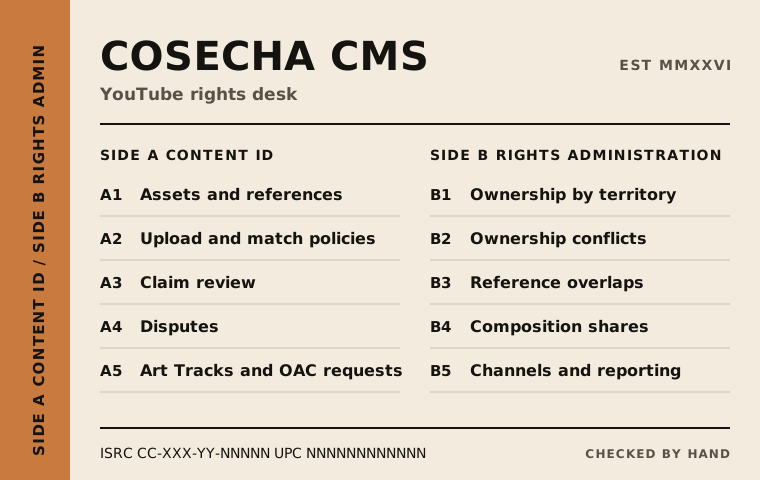
Side A is Content ID: the assets, reference files and policies that decide what happens when someone else uploads your music. Side B is rights administration: who owns what, in which territory, and what to do when two owners say the same thing.
Content Manager is YouTube's web tool for partners who manage content and rights on YouTube. From it, a partner can link channels, control the monetization of their videos and give each user a role that limits what they can do. We work in that tool with you, under the role you choose to give us.
Some catalogs need both sides from day one. Others need one side cleaned up before the other makes sense. We start by reading what is there.

Content ID.
Content ID finds copyright-protected content in uploads by comparing them against files that rights holders submit. A claim can block a video, monetize it or track its viewership, and the action can differ by country. Getting that right starts with clean assets.
Assets and references
Sound recording, music video, Art Track and composition share assets, each with the metadata YouTube asks for. Each reference file must represent one piece of intellectual property, and you must hold exclusive rights to it in every territory you claim.
Upload and match policies
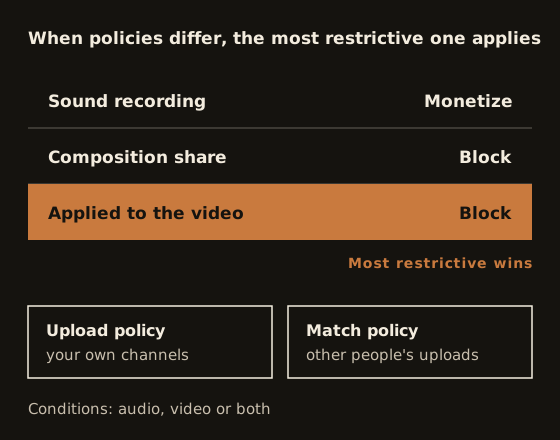
Upload policies cover your own channels. Match policies cover other people's uploads that Content ID matches, with conditions such as audio only, video only or both. We set them with you, release by release.
Claim review
Manual claiming is only for gaps that automatic matching missed, and every manual claim needs human review. Automation is not allowed. We never manually claim a video that an asset for the same content claims now or claimed before.
Disputes
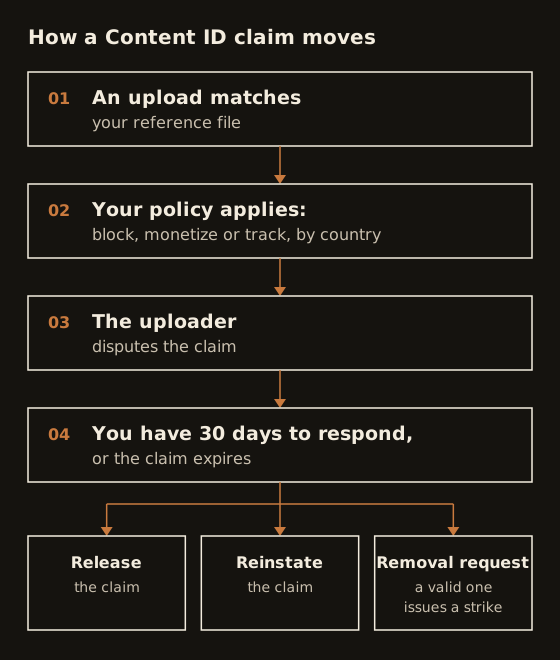
When an uploader disputes a claim, the claimant has 30 days to respond or the claim expires. We review each dispute against your rights and bring you a recommendation: release, reinstate, or in clear cases a copyright removal request. A valid removal request means a strike on the uploader's channel, so it is never a default.
Art Tracks and OAC requests
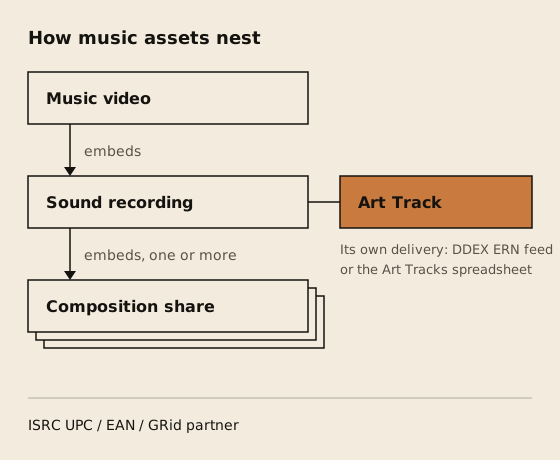
An Art Track is an automatically generated YouTube version of an album track, available to label and distributor partners who use Content Manager. Creating a sound recording asset does not by itself create one. We prepare the delivery. For artists who qualify, we prepare Official Artist Channel requests and submit them through your Content Manager. YouTube decides each request.
Some material can never be a reference: content licensed non-exclusively, Creative Commons and public domain works, karaoke recordings, remasters, sound-alikes, compilations, continuous DJ mixes, mashups and full-album sound recordings. We check before anything is delivered.
YouTube identifies each Art Track byISRC · UPC / EAN / GRid · partner
Rights administration.
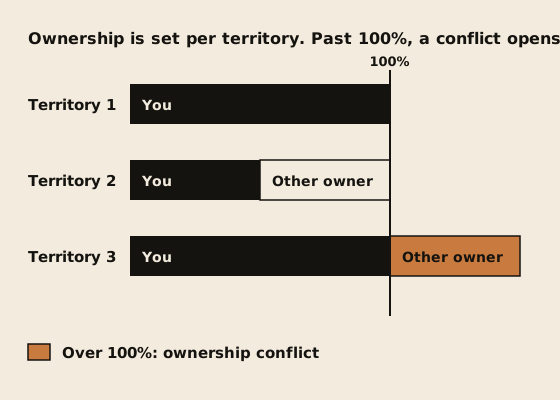
Ownership is the data underneath every claim. When it is wrong, claims land in the wrong place. Side B keeps it right, territory by territory.
Ownership by territory
Ownership is set per asset and per territory. We check it against your agreements and keep it current as deals change.
Ownership conflicts
A conflict opens when owners together assert more than 100% ownership in a territory. It is resolved from the Issues page: request a transfer, remove your own ownership, or email the other owner. We document your position and work it through.
Reference overlaps
When two reference files claim the same content, the partner with the newest reference has 30 days to exclude the overlapping segment or assert exclusive ownership. While it stays unresolved, claims remain with the partner who delivered first.
Composition shares and publishers
A sound recording embeds one or more composition shares. Labels should not create composition share assets without an appropriate contract, so publishing assets go in only with the paper behind them. Publishers can bring their compositions to the same desk.
Channels and monthly reporting
Channels linked to the right owner. YouTube publishes partner reports on a set schedule, with assets and claims daily and references weekly. We deliver yours on a fixed schedule each month and reconcile them against what you expected to see.
How an engagement runs.
Consulting stops after an audit or a cleanup. Ongoing administration runs all four steps, every month.
Audit
We go through your Content Manager asset by asset: metadata, references, ownership, policies, open issues. You get a written list of findings, in English or Spanish.
Policy
We agree the rules with you: what to monetize, what to track, what to block, country by country and release by release.
Cleanup and onboarding
Conflicts, overlaps, broken metadata and missing assets, fixed in order of what they cost you. New releases delivered with ISRCs, UPCs and credits checked by a person, accents kept.
Monthly administration
Claims and disputes reviewed, conflicts worked, Art Track and OAC requests handled, reports delivered on a fixed schedule and reconciled.
Terms are set in conversation and written into the agreement. There is no checkout and no plan to pick.

Who it is for.
Built for
- Independent labels with a catalog on YouTube and nobody watching the claims.
- Labels that already have Content Manager and want it run properly.
- Publishers who need composition shares administered next to the recordings.
- Catalogs in Spanish and English: Regional Mexican, cumbia, urbano and more.
Look elsewhere if
- You want a self-serve dashboard and no conversation.
- You want revenue promises before anyone has looked at your catalog.
- You want claims placed on music you do not control exclusively.
- You want manual claiming automated. YouTube does not allow it, and neither do we.

Questions.
Do I need my own Content Manager to work with you?
Not to start the conversation. Content ID is available to copyright owners who meet YouTube's criteria, including exclusive rights to a substantial body of original material that is frequently uploaded. YouTube decides eligibility, not us. If you already have Content Manager, we work inside it. If you do not, we review your catalog and rights and tell you plainly whether a Content ID application makes sense.
Do you take ownership of our content?
No. You keep your rights. We act as administrator under your instruction, with the user role you give us in your Content Manager, and you decide what that role can do.
Do you work with distributors?
Yes. Many labels deliver through a distributor and handle YouTube rights separately. We coordinate with whoever delivers your releases so that metadata and ownership agree.
Can you guarantee claims, revenue or an Official Artist Channel?
No. Eligibility and approvals are YouTube's decisions, and dispute outcomes depend on YouTube's process and the uploader, not on us. What we commit to is the work: every claim reviewed by a person, every conflict documented, every report delivered.
Do you work in Spanish?
Yes. Every engagement runs in English or Spanish, your choice, and your metadata keeps its accents.
What does it cost?
It depends on the catalog and the work. Terms are set in conversation and written into the agreement.

Request a catalog review.
Tell us about the catalog. A person reads every inquiry and replies in your language.